Published
The short answer
Sometimes. Under schedule 1, section 13 of the Building Regulation 2021, a small deck, pergola or other outdoor structure is accepted development and needs no building approval if its plan area is no more than 10 m², no side is longer than 5 m, and it stands no more than 2.4 m above natural ground, with a mean height of no more than 2.1 m. A deck also has to be unroofed and no more than 1 m above the ground, and the rule doesn't apply in Wind Region C (the tropical cyclone area) or to a pool fence. Even then, "the owner is responsible for ensuring the work complies with applicable standards, including structural sufficiency, size limits and boundary setbacks", and in Brisbane a character overlay or neighbourhood plan can add a planning approval. Anything bigger, higher or roofed is a question for a private building certifier before work starts.
Who decides whether a deck needs approval
In Queensland, building approvals are issued by building certifiers, not by the council. Brisbane City Council puts it this way: "A private building certifier is the assessment manager for building work applications. Council acts as a referral agency providing advice for the application."
Certifiers are licensed too. Business Queensland says "All building certifiers must be licensed with the Queensland Building and Construction Commission (QBCC)", and that "Building certifiers must not design the building or carry out any of the work." So the certifier checks the deck; a separate licensed contractor builds it.
The approval is the owner's responsibility. The QBCC says: "It's your responsibility as a home owner to make sure the right building approvals are in place before work starts—even if you've hired a builder." It adds: "Usually, your builder will engage a certifier on your behalf. However, you can choose to appoint a certifier directly."
Decks and pergolas that don't need building approval
The Building Regulation 2021 lists the building work that needs no building approval in schedule 1, headed "Accepted development (self assessable)". Section 13 covers decks, pergolas and other outdoor (class 10) structures, and sets four tests: a plan area of no more than 10 m², counting overhangs and any existing part; no side longer than 5 m; a height of no more than 2.4 m above natural ground; and a mean height of no more than 2.1 m. A deck is left out of the section if it's roofed or more than 1 m above its natural ground surface.
Those limits are tight. A 3 × 3 m deck off the back door can qualify; a deck that runs the width of a house, or one off a highset verandah, won't. Many pergolas stand taller than 2.4 m to the top of the frame, which takes them outside the section too, so they usually need a certifier's approval.
Accepted development isn't the same as "anything goes". Business Queensland says: "If the work is accepted development (self assessable), the owner is responsible for ensuring the work complies with applicable standards, including structural sufficiency, size limits and boundary setbacks." It also warns that "Minor building work may require approval under local government planning schemes."
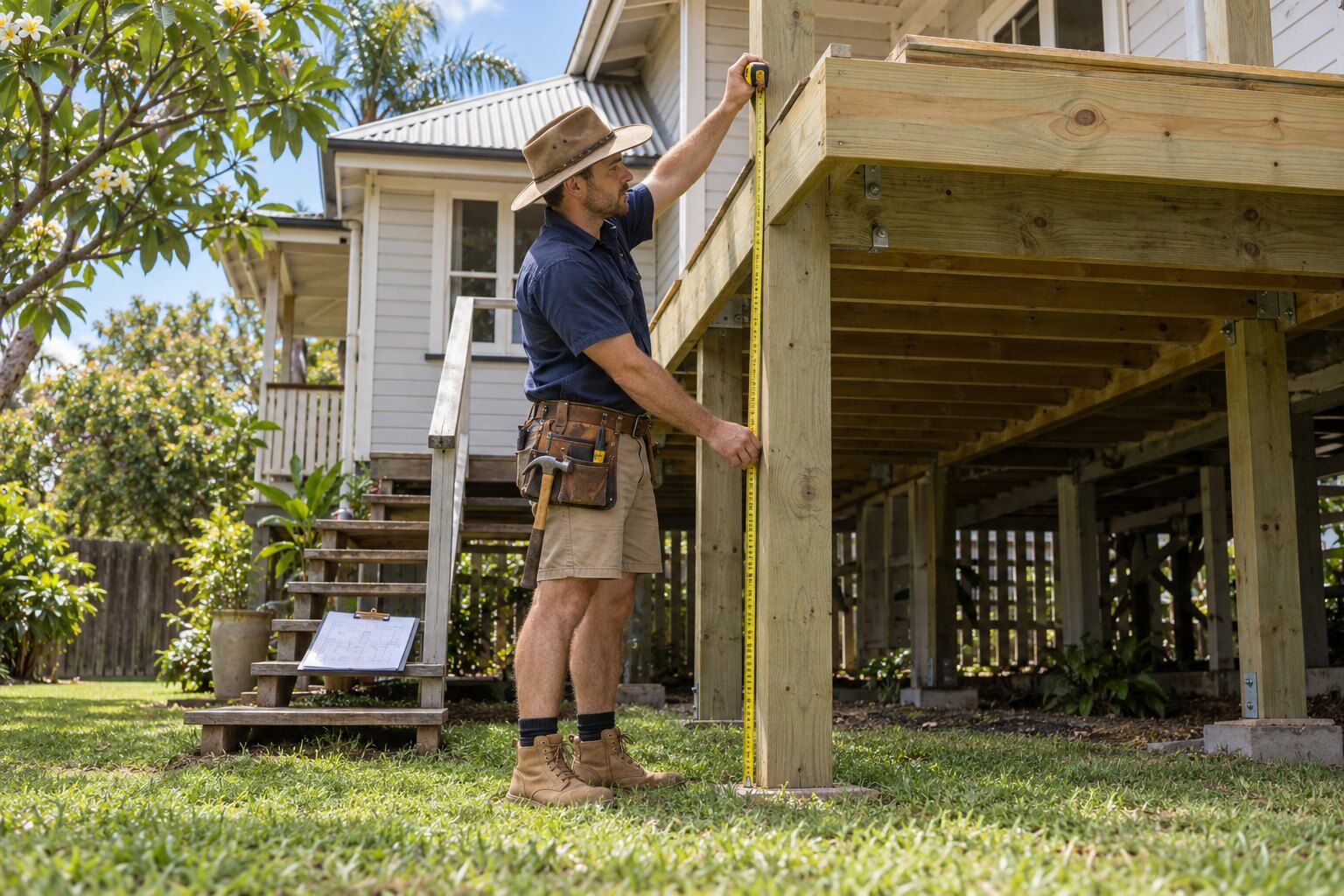
Before you ask a certifier, have these measurements ready. They're the details that usually decide it:
- The deck or pergola's plan size, in square metres
- How high the deck floor sits above the ground at its highest point, and the overall height of any roof
- Whether it has a roof, and what kind: open battens, shade cloth, polycarbonate or sheet metal
- Whether it's attached to the house or freestanding
- How close it comes to each boundary, and whether it's in front of the house
Planning approval in Brisbane: height, setbacks and character
A building approval and a planning approval are different things. Business Queensland explains: "Some aspects of domestic building work—such as maximum height, setback or character of a building—may be controlled under a local government planning scheme. In that case, a planning permit is required from the local government." In Brisbane, that scheme is City Plan 2014.
The character overlays matter most for decks on older houses. For a site in the Traditional building character overlay, Brisbane City Council says "you'll generally need planning approval for external extensions", and adds: "These requirements are subject to change. Check table 5.3.4.1 Prescribed accepted development in City Plan for the circumstances where planning approval is not required." Our guide to renovating a Queenslander covers the overlays.
To see which overlays apply to your block, Council says to "Enter your address in the search bar of City Plan online", apply the overlays from the Map Layers menu, and download a Property Lot Report. You can also "Phone Council on 07 3403 8888 and ask to speak with a Planning Information Officer."
When a deck needs a balustrade
Highset Brisbane houses often have decks and verandahs well above the ground, so the balustrade rules come up on most of them. They come from the National Construction Code's housing provisions, and a certifier confirms how they apply to your deck.
- When a barrier is needed: "where it is possible to fall 1 m or more measured from the level of the trafficable surface to the surface beneath".
- How high: "not less than 1 m above the floor of any landing, corridor, hallway, balcony, deck, verandah" and similar areas.
- Gaps: openings must not "permit a 125 mm sphere to pass through".
The same wording appears in NCC 2022 and NCC 2025. If the deck has stairs, give their height in your enquiry too, so the stairs and balustrade are quoted together.
Repairing or replacing part of an existing deck
Repairs are treated differently from new work. Schedule 1 of the Building Regulation includes "Particular repairs, maintenance or alterations not affecting structural component or fire safety system", and, for repairs that only affect structural components, the accepted work is limited to repairs that do "not affect more than 20% of the building's structural components of the same type".
Brisbane City Council's fact sheet on repairing houses after severe weather follows the same line: "Minor like-for-like repairs to non-structural external cladding" need no building approval, but "Substantial repairs to structural and non-structural framing members (more than 20% to structural and non-structural framing members)" do.
So replacing worn deck boards or a few rotten joists usually differs from rebuilding the frame. If a repair would replace more than a fifth of the posts, bearers or joists, ask a certifier before work starts.
Who can build the deck or pergola
Approval and licensing are separate questions. Building work valued over $3,300, counting labour, materials and GST, needs a contractor with a QBCC licence of the right class. The QBCC Act says "a person must not carry out, or undertake to carry out, building work unless the person holds a contractor's licence of the appropriate class". The Builder – Low Rise class covers "Building work on a class 1 or class 10 building."
Check the licence and its class on the QBCC licensee register before you sign, and see carpenter or builder: QBCC licences for contracts and deposits. When you send a deck enquiry, include the size, the floor height, whether it has a roof and how close it is to a boundary, so the quote from a QBCC-licensed local carpenter covers the approval question.
Questions about deck and pergola approvals
Do I need council approval for a deck in Brisbane?
Building approvals in Queensland come from a private building certifier, not the council. Brisbane City Council acts as a referral agency. Separately, Council's planning rules (City Plan) can require a planning approval for things like height, setbacks and character, so a deck on a house in a character overlay can need one.
Does a low deck need a building approval in Queensland?
Not if it meets every test in schedule 1, section 13 of the Building Regulation 2021: unroofed, no more than 1 m above the ground, a plan area of no more than 10 m² and no side over 5 m. You still have to make sure it complies, "including structural sufficiency, size limits and boundary setbacks". A bigger low deck needs a building certifier's approval.
Do I need approval for a pergola in Queensland?
A freestanding pergola is accepted development only if it's no more than 10 m², no side is over 5 m, and it's no more than 2.4 m high, with a mean height of no more than 2.1 m. Many pergolas are taller than 2.4 m, so they need a certifier's approval. Give a certifier the plan size, height, roof type and boundary distances.
Who applies for the building approval?
The QBCC says that "Usually, your builder will engage a certifier on your behalf. However, you can choose to appoint a certifier directly." Either way, it's the owner's responsibility to have the right approvals before work starts.
How high does a deck have to be to need a balustrade?
Under the National Construction Code's housing provisions, a barrier is needed "where it is possible to fall 1 m or more". On a deck or verandah it must be at least 1 m high, and its openings must not let a 125 mm sphere through.
Can I replace deck boards without approval?
Like-for-like replacement of worn boards is a repair, not new building work. Repairs to a minor structural component can be accepted development if they don't change the deck's size or height and don't affect more than 20% of the structural components of the same type. Replacing much of the frame can need a building approval, so ask a certifier.
Does a carpenter need a QBCC licence to build a deck?
For building work valued over $3,300, including labour, materials and GST, yes: the contractor needs a QBCC licence in the right class. Check it on the QBCC licensee register.
Where this information comes from
The rules on this page come from these published pages, checked on 28 October 2026.
- Building Regulation 2021 (Qld) · Queensland legislation, version in force from 14 August 2026 (schedule 1, accepted development, including section 13)
- Queensland Building and Construction Commission Act 1991 · Queensland legislation, version in force from 1 February 2026 (s 42, s 53C, schedule 1B)
- QBCC: Builder – Low Rise licence · Queensland Building and Construction Commission licence class page, last reviewed 30 August 2021
- Brisbane City Council: repairing or rebuilding dwelling houses after a severe weather event · Brisbane City Council fact sheet, March 2025
- Business Queensland: when you don't need building approval · Queensland Government, last reviewed 23 June 2022
- Business Queensland: role of building certifiers · Queensland Government, last reviewed 14 July 2026
- QBCC: building approvals and certification · Queensland Building and Construction Commission, last reviewed 17 April 2025
- Brisbane City Council: extensions, raising or renovations · Brisbane City Council, published 15 April 2025
- Brisbane City Council: heritage and character properties · Brisbane City Council, published 31 March 2025
- NCC Housing Provisions, part 11.3: barriers and handrails · Australian Building Codes Board, the national barrier rules (the same wording in NCC 2022, which Queensland applies until 1 May 2027)
- QBCC: when you need a licence · Queensland Building and Construction Commission, last reviewed 11 August 2021