Stair and balustrade work on Brisbane houses
Brisbane has more outside stairs than most cities. Highset houses and Queenslanders on stumps have a long run of front or back stairs, raised decks need stairs down to the yard, and verandahs and decks need balustrades that hold. Timber outside takes sun and rain, and stairs take the most wear of all.
Replacing worn or split treads
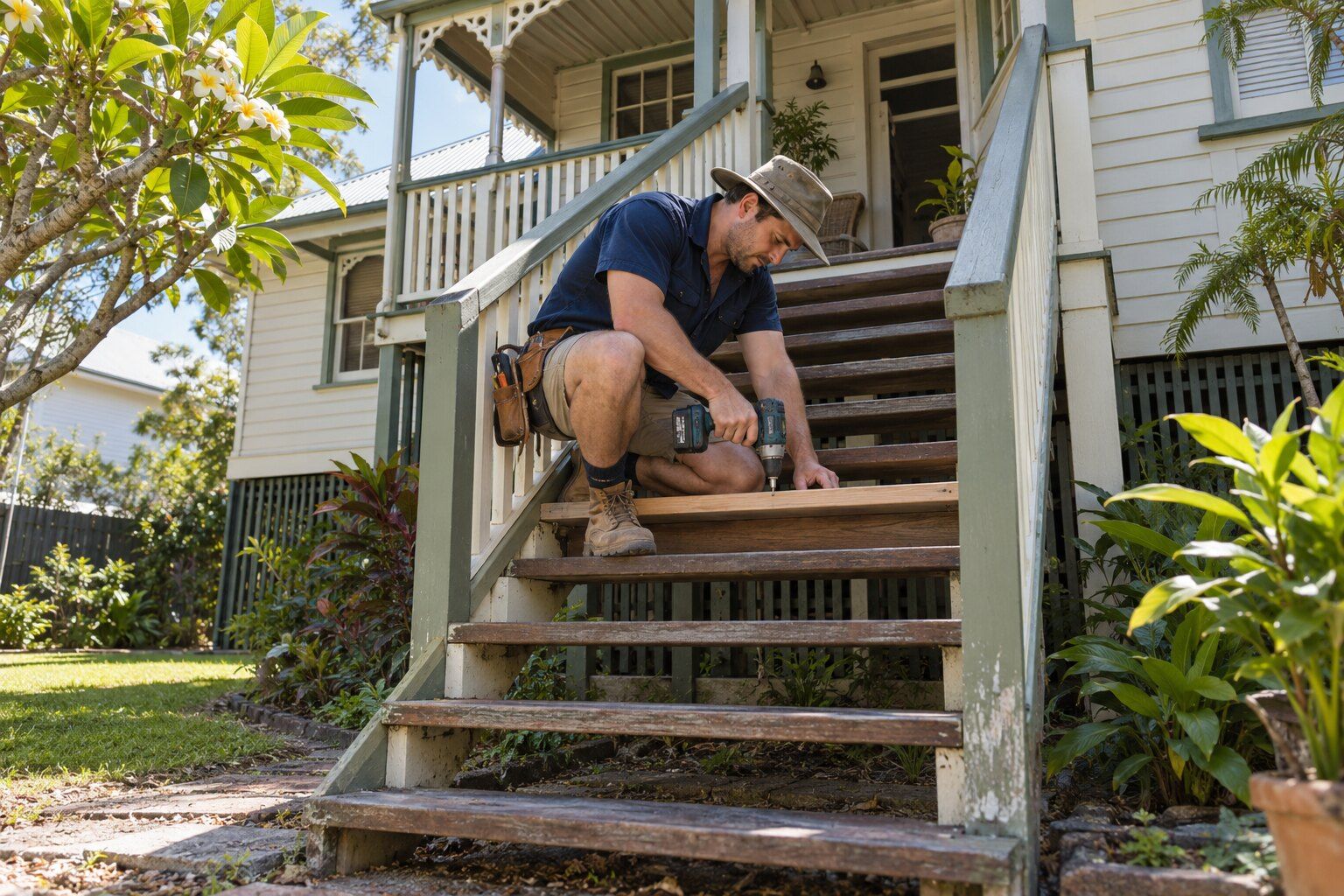
Split, cupped or soft treads are replaced with new treads of the same size, fixed to the stringers with screws or bolts so they stay tight.
Rotten stringers and bottom steps
Stringers rot first where they meet the ground or a concrete pad. Short lengths can sometimes be repaired; a stringer that's soft along its length is replaced, which usually means taking the stair apart.
Queenslander front stairs
The long front stairs of a highset Queenslander, often with turned or square timber balusters and a handrail down each side. Worn parts are repaired to match, or the stair is rebuilt in the same style.
New deck stairs
A new stair down from a raised deck, with a landing where it turns and handrails to match the deck balustrade.
Balustrades and handrails
Loose balustrade posts refixed, and low or wide-gapped balustrades replaced in timber, aluminium, glass or stainless wire. Handrails are refixed or replaced where they've worked loose.
How much do stairs and balustrades cost in Brisbane?
Stair and balustrade work is priced after the carpenter has seen it or clear photos. The number of steps, the height of the top landing, whether the stringers can stay, the timber, and the length and type of balustrade set the price. Replacing a few treads is a small job; rebuilding a full highset stair is a large one.
Published carpenter rates are on the carpenter rates page. If the job comes to more than $3,300, counting labour, materials and GST, it needs a QBCC-licensed contractor and a written contract.
Balustrade rules in Queensland
Queensland applies the National Construction Code. It requires a barrier where it's possible to fall 1 m or more, measured from the floor or step to the surface beneath. On a deck, verandah, balcony or landing, the barrier must be at least 1 m high, and its openings must not let a 125 mm sphere pass through (NCC Housing Provisions, part 11.3).
The wording is the same in NCC 2022, which Queensland applies until NCC 2025 starts on 1 May 2027. The code also sets rules for stair steps and handrails, so a rebuilt stair is set out to the code rather than copied from the old one.
Older balustrades
Many older decks and verandahs have balustrades that are lower than 1 m or have wider gaps. Replacing one is a good time to bring it up to the current rule.
When stair repairs need a builder or certifier
Treads, handrails and balusters are repairs. Stringers, posts and the beams a stair hangs from carry its load, so replacing them is structural work: over $3,300 it needs a contractor whose QBCC licence class covers it. The carpentry class includes building timber stairs.
The Building Regulation lets some structural repairs go ahead as accepted development only where they don't affect "more than 20% of the building's structural components of the same type". A new stair, or rebuilding most of an old one, is a question for a building certifier before work starts.
Front stairs and balustrades on character houses
On a house built in 1946 or earlier in one of Brisbane's character overlays, the front stair and verandah balustrade are part of the street front the overlay protects. City Plan's list of accepted development includes taking out balustrades, along with windows, doors, window hoods and fretwork, so they can be replaced with new features "of the same style and appearance". A change in style is a different question.
Check with Council or a building certifier before a front stair or balustrade changes its look. The Queenslander renovation guide explains the overlays, and Queenslander carpentry covers verandahs, VJ walls and windows.
What to send with your enquiry
- Photos of the stairs from the bottom and the top, and of the worst steps
- How many steps, and roughly how high the top landing is
- What the stairs and balustrade are made of now
- Whether you want repairs, a new balustrade or a full rebuild
- The year the house was built, and whether it's a Queenslander or highset house
Questions about stairs and balustrades in Brisbane
How high does a balustrade need to be in Queensland?
Under the National Construction Code, which Queensland applies, a barrier is needed where it's possible to fall 1 m or more. On a deck, verandah, balcony or landing it must be at least 1 m high, with no opening that lets a 125 mm sphere through.
Can worn treads be replaced without rebuilding the stairs?
Usually, if the stringers are sound. Split or soft treads are replaced one by one. If the stringers are rotten, the stair generally has to come apart.
Can Queenslander front stairs be rebuilt in the same style?
Yes. In the character overlays, City Plan's accepted development list covers replacing balustrades with new features of the same style and appearance. Changing the style is a question for Council or a certifier first. See renovating a Queenslander.
Do new stairs need a building approval?
A new stair, or rebuilding most of an old one, is structural work, so ask a building certifier whether it needs an approval before work starts. Replacing treads and handrails is a repair.
Timber, glass or wire balustrades?
Timber suits Queenslanders and timber decks, glass keeps a view open, and stainless wire is light and modern. Any of them has to meet the 1 m height and 125 mm opening rules.
Where this information comes from
The rules and figures on this page come from these published pages, checked on 28 October 2026.
- NCC Housing Provisions, part 11.3: barriers and handrails · Australian Building Codes Board, the national barrier rules (the same wording in NCC 2022, which Queensland applies until 1 May 2027)
- Building Regulation 2021 (Qld) · Queensland legislation, version in force from 14 August 2026 (schedule 1, accepted development, including section 13)
- Brisbane City Plan 2014, table 5.3.4.1: prescribed accepted development · Brisbane City Council planning scheme, version 37 (effective 18 September 2026)
- Brisbane City Council: heritage and character properties · Brisbane City Council, published 31 March 2025
- QBCC: when you need a licence · Queensland Building and Construction Commission, last reviewed 11 August 2021